AI that reduces the documentation burden in regulated environments
We help in-vitro diagnostics and medtech companies take the documentation work that adds no product value — review, cross-checking, traceability — off their engineers' hands, using AI deployed on your own infrastructure. No data ever leaves your network. Your quality system stays untouched.
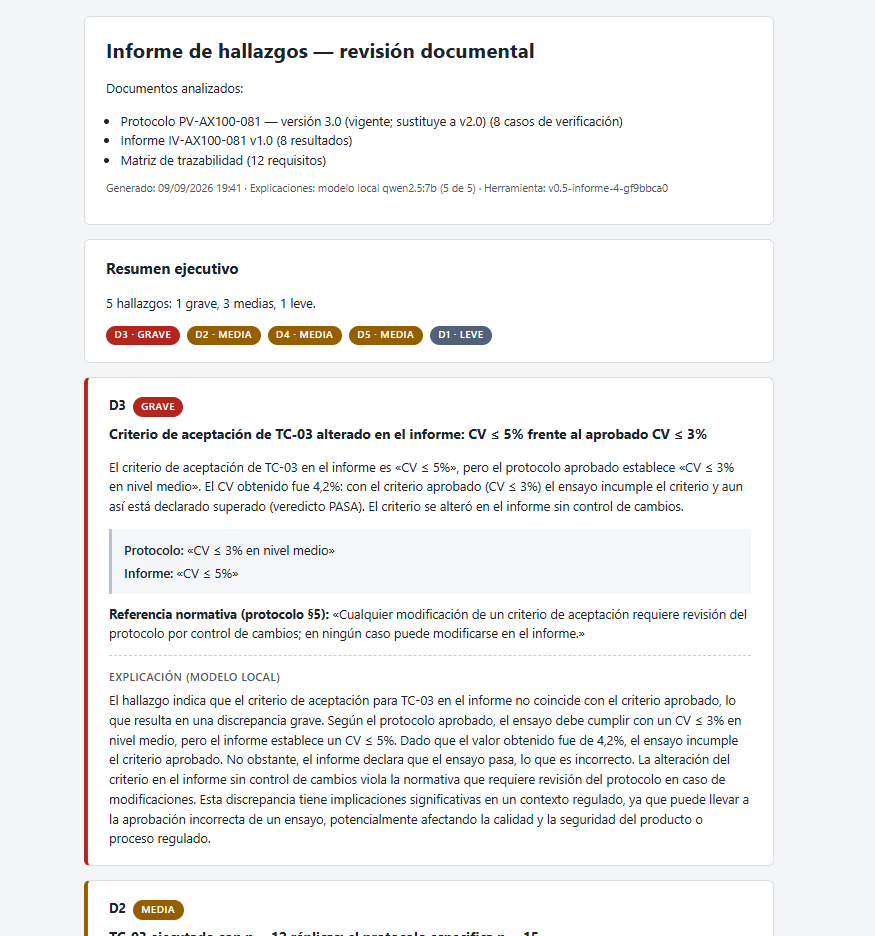
Review cycles burn engineering hours that should go into the product
In regulated R&D teams, a substantial share of engineering time goes into documentation: requirements and their traceability, verification protocols and reports, design documentation, technical file contributions. The biggest cost is not the writing: it is the review cycles. Documents that go back and forth two or three times between issue and sign-off because of mechanically detectable defects — inconsistencies between protocol and report, requirements without coverage, unrecorded changes. Every cycle burns author and reviewer hours, and adds weeks to project milestones.
General-purpose AI tools do not solve this in your sector, for two reasons: they know nothing about the formats and logic of a regulated quality system, and they require sending confidential development documentation to third-party servers, running on models that change without notice and therefore cannot be validated.
The system assists the engineer before the document enters the formal review loop
What it does. The system reads the agreed documentation scope — read-only — and generates findings reports for the authoring engineer, before the document enters the formal review loop:
- Protocol–report cross-checking: consistency between what was specified and what was reported.
- Traceability verification: requirement coverage by verification cases, dangling references.
- Version comparison: undocumented changes between revisions.
- Completeness review against your QMS checklists.
- Transformation of existing content: test results into report format, traceability matrices, master protocol adaptation.
- It does not create, modify or approve any record in your quality system: it connects read-only.
- It does not draft critical content. The author and approver of every document remain exactly who they are today.
- It does not replace any step of your review loop, and it does not shift responsibilities.
- It does not catch 100% of defects. No tool does — automated or human — and you should distrust anyone who promises otherwise. That is why it sits before your review, not instead of it, and why it is validated with measured metrics, not promised ones.
Your documentation does not need to leave your company
Your development documentation does not need to leave your company. We work with open-source AI models deployed on a server you own, inside your network: when the system analyses a document, the document travels from your repository to your server and back. No external calls, no telemetry, and the option to operate with no internet access at all. Your IT team can verify it by inspecting network traffic: the guarantee is architectural, not contractual.
You define the access perimeter: the system only indexes the folders or projects agreed, and every query is logged. Usage metrics are aggregated by process — never by person.
A tool your quality department can assess
The tool comes with its validation file prepared, so your quality department can assess it under your own software validation procedure: documented intended use, frozen model version (no silent update can ever alter what you validated), a test bench of documents with known planted defects and a measurable detection criterion, and change control with a regression suite for any update. We include a reasoned classification of the tool under the EU AI Act.
Three stages of growing commitment
We know this problem because we have lived it from the inside
Behind this project there are 18 years developing in-vitro diagnostics instrumentation as a senior system engineer and project manager at leading companies in the sector, plus 4 years in space projects. We have written, reviewed and chased design documentation in regulated environments for an entire career: we know this problem because we have lived it from the inside, not from a generalist AI consultancy. That is why this product is deliberately conservative where it must be — nothing touches your quality system without validation and a human signature — and ambitious where it can be: giving your engineers back the hours that mechanical error-hunting consumes today.
What quality managers usually ask first
Let's talk about your case
Tell us briefly about your situation and we will reply within 48 working hours. The first conversation carries no commitment: we are as interested in understanding your documentation burden as you are in solving it.